
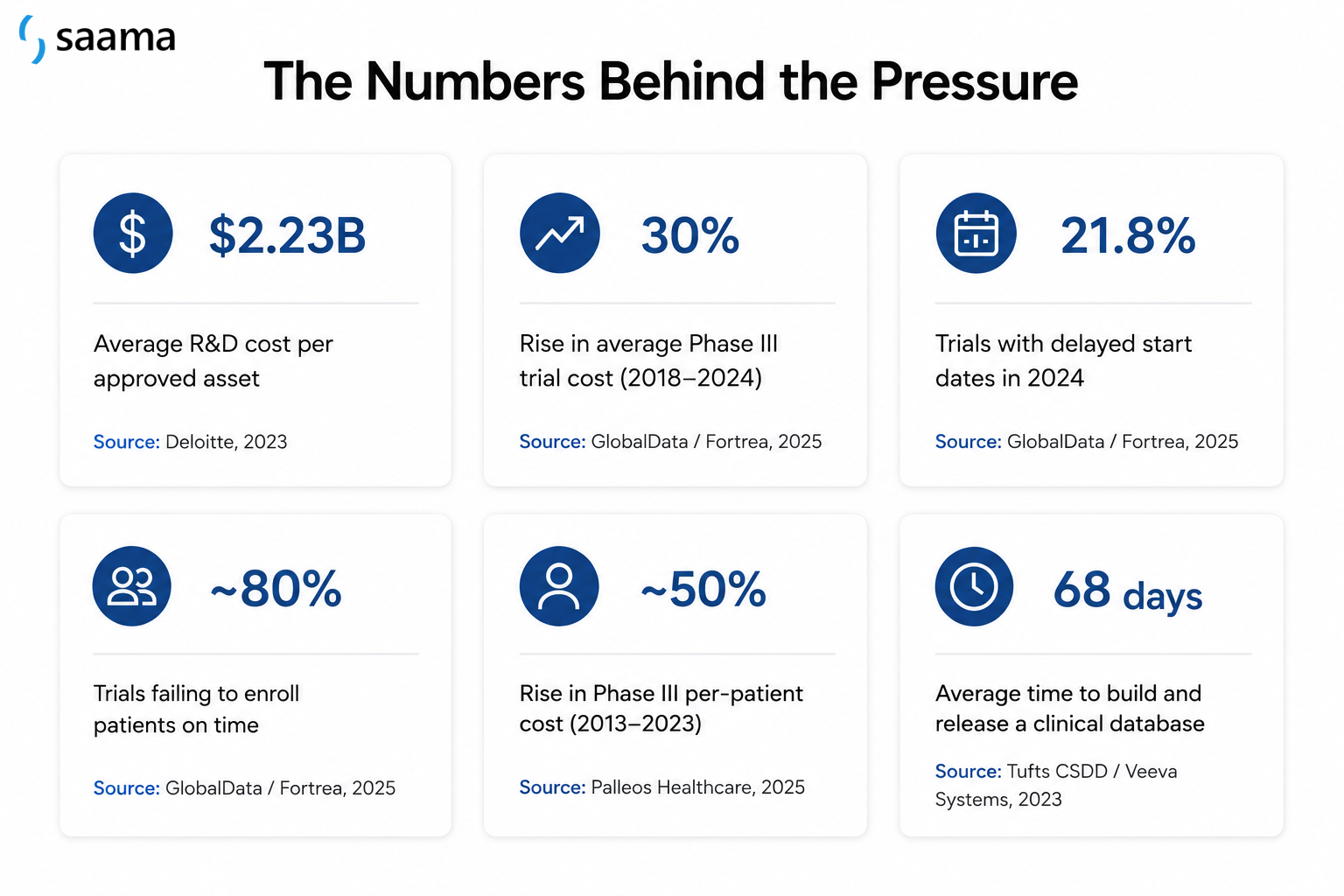
Clinical development has always been expensive. But in 2026, the economics are drawing sharper attention. Developing a single new molecular entity now routinely requires between $2 billion and $2.6 billion per approved drug, when accounting for capital costs and the rate of clinical failures across a development lifecycle that can span 10 to 15 years. [Congressional Budget Office, 2021; IFPMA Facts and Figures, 2025].
Costs at this scale are not new. What is new is the pace at which they are rising, and the growing recognition that a significant portion of what is driving them up is not scientific complexity, but operational inefficiency.
Where the Cost Is Actually Being Generated
It is tempting to attribute rising clinical development costs entirely to factors that are difficult to change, such as complex trial designs, smaller patient populations, and higher regulatory expectations. These are legitimate contributors, but they do not fully account for the trajectory.
A significant portion of cost escalation originates in how clinical data is managed. A decade ago, most trial data resided in a centralized EDC system. Today, it arrives continuously from multiple sources:
- Electronic health records and eSource platforms
- Wearable devices and remote monitoring tools
- Local and central laboratories
- Genomics and biomarker data providers
Each of these streams adds volume, variety, and complexity to the data management process. The workflows used to clean, review, and reconcile that data, however, have largely remained the same. That gap between data complexity and operational process is where a meaningful portion of avoidable cost is being generated.
Where That Gap Shows Up in Practice
The consequences of this mismatch are visible across the trial lifecycle. Teams operating under these conditions typically encounter a predictable set of friction points:
- In data-intensive environments, teams commonly report spending approximately 80% of their working time on data collection, preparation, and cleaning, leaving only 20% for analysis. [Forbes / IDC] Clinical data management operates under similar pressures, with activities such as query management, vendor data reconciliation, medical coding, and SAE reconciliation consuming the majority of team bandwidth before any meaningful review of safety or efficacy data can begin
- Query volumes in large, multi-site studies accumulate faster than they can be resolved under manual review workflows
- Database build delays at study startup create downstream effects that persist through to lock. Organizations that release the study database after the first patient, first visit take approximately 75% longer to reach database lock than those that release it before [Tufts CSDD / Veeva, 2023]
- Late-stage data corrections, identified at or near database lock rather than earlier in the trial, are among the most resource-intensive interventions in clinical development
- Submission timelines compress or slip as a downstream consequence of delays that originated much earlier in the process
The Accumulated Cost of Fragmented Tools
When a workflow becomes a bottleneck, the common response is a targeted solution: a standalone coding platform, a risk-monitoring tool, or a data-mapping application. Each decision is defensible in isolation. Over time, the result is a technology infrastructure of disconnected systems that were not designed to interoperate, resulting in inconsistent data standards, manual reconciliation overhead, and visibility gaps between teams that are rarely attributed to the technology choices that cause them.
Outsourcing to CROs helps in many respects, but does not resolve the underlying issue. A CRO operating on fragmented tools encounters the same reconciliation burden as an in-house team. The structural inefficiency travels with the architecture, not with the organization managing it.
How Saama Approaches This
Saama’s platform is designed around the premise that clinical data management, quality review, medical coding, and cross-functional review are interconnected stages of a single process, and are more efficiently managed within a connected environment than across separate systems.
In practice, this means:
- Data from EDC systems, eSource, laboratories, and wearables is ingested and standardized in one place using 40+ pre-built connectors
- Quality monitoring operates continuously rather than in batch cycles, allowing anomalies to be identified earlier in the trial when resolution is less resource-intensive
- Data managers, medical monitors, and clinical operations teams work from shared interactive review listings, reducing the back-and-forth that typically slows cross-functional alignment
The practical impact shows up where it matters most: earlier anomaly detection, reduced query volumes at closeout, and a more predictable path from last patient, last visit to a submission-ready dataset.
See It in Practice
Understanding where operational inefficiency sits in your development model is the first step. Seeing how a connected platform addresses it is the next. Schedule a demo with the Saama team to walk through how Data Hub and Smart Data Quality work within your specific trial environment.
Frequently Asked Questions
Q1. What are the biggest cost drivers in clinical trials?
A. Clinical trial costs are driven by a combination of factors, including trial design complexity, extended development timelines, patient recruitment and retention challenges, and the operational overhead associated with managing, aggregating, and cleaning high volumes of multi-source clinical data across disconnected systems.
Q2. How can AI and technology reduce clinical development costs?
A. Technology platforms can support cost reduction by automating repetitive data management processes, standardizing data ingestion from multiple external sources, identifying data anomalies earlier in the trial lifecycle, and reducing the manual effort required to reach database lock, each of which helps compress timelines and reduce the cost of late-stage corrections.
Q3. How do CROs help manage clinical development costs?
A. CROs contribute through operational scale, site access, and therapeutic expertise. Their ability to drive efficiency is directly tied to the tools and processes they operate on. Unified platform architectures can reduce the reconciliation burden caused by fragmented systems, regardless of whether the operating team is a sponsor or a CRO.
Q4. How much does clinical development cost on average?
A. Developing a single new molecular entity typically requires between $2 billion and $2.6 billion per approved drug, accounting for capital costs and the rate of clinical failures across the full development lifecycle. [Congressional Budget Office, 2021; IFPMA Facts and Figures, 2025]