
Somewhere in every clinical trial, a patient tells an investigator they have a “splitting headache.” Another says their head is “pounding.” A third calls it “the worst migraine of my life.” Three patients, three phrasings, one medical concept. Multiply that by thousands of adverse events, medications, and medical history terms across a single study, and you start to see the scale of a problem most people outside clinical data management have never heard of: medical coding.
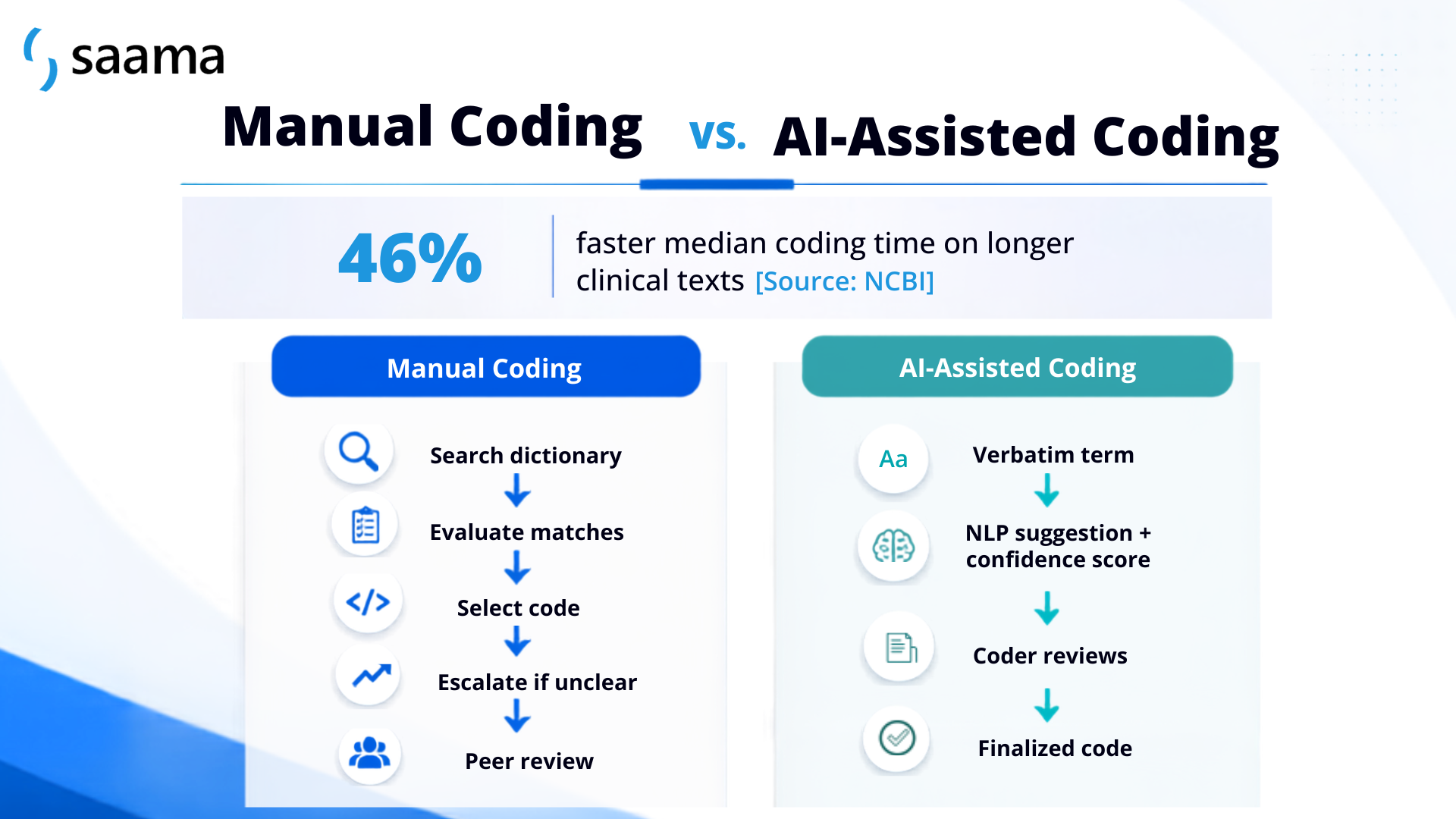
It’s understated work, but it’s foundational. This guide walks through what medical coding actually is, why AI is starting to reshape it, what to look for when choosing medical coding software, and how the platforms on the market today, including Saama’s own Smart Medical Coding (SMC), stack up. The upside of getting this right is real and measurable: in a randomized crossover trial, an AI-assisted coding tool reduced median coding time by 46% for longer clinical texts compared with manual coding [Source: National Center for Biotechnology Information (NCBI)].
What Is Medical Coding in Clinical Trials?
Medical coding is the process of taking verbatim terms, the exact words a patient, investigator, or site staff member used to describe a symptom, diagnosis, or medication, and mapping them to standardized terms in a controlled medical dictionary.
Two dictionaries dominate clinical research:
- MedDRA (Medical Dictionary for Regulatory Activities): codes adverse events, medical history, and other clinical findings into a standardized hierarchy of terms.
- WHODrug (World Health Organization Drug Dictionary): codes concomitant medications and drug exposures into standardized drug names, ingredients, and classifications.
Go back to that headache example. “Splitting headache,” “pounding head,” and “worst migraine of my life” all need to land on the same standardized MedDRA term. Skip that step, and the same medical concept splinters into dozens of different phrases scattered across your dataset, quietly making it impossible to spot real safety signals or compare results across sites and studies.
Why Medical Coding Matters More Than It Gets Credit For
- Safety monitoring depends on it. Regulators and sponsors spot adverse event patterns in coded terms, not raw verbatims. Sloppy coding can bury a real signal or manufacture a false one.
- Regulatory submissions require it. MedDRA and WHODrug coding is table stakes for submissions to agencies like the FDA and EMA.
- Cross-study analysis lives or dies by consistency. Sponsors running multiple trials need coding decisions that hold up across studies, not just within one.
- Everything downstream depends on it being clean. Coding errors don’t stay contained. They ripple into every table, listing, and figure used for internal and regulatory review.
Why the Manual Process Buckles Under Its Own Weight
Here’s how it typically goes: a coder reviews each verbatim, searches the dictionary for a match, and either accepts it, creates a synonym mapping, or flags it for escalation. A second coder or reviewer checks the work before it’s finalized. Simple in theory. In practice, it runs into friction fast:
- Volume: large trials can throw off tens of thousands of verbatim terms.
- Ambiguity: misspellings, abbreviations, and regional language quirks complicate every match.
- Inconsistency across coders and studies: two reasonable coders can land on two different answers for the same term.
- Dictionary version upgrades: MedDRA and WHODrug update on a regular cycle, and each update can trigger impact analysis or recoding of terms you thought were done.
- Review cycles: peer review, query resolution, and sponsor sign-off all add time before anything is finalized.
This is exactly the backdrop against which AI medical coding, or smart medical coding, has emerged: a category of tools built to strip out the manual search burden without stripping out human oversight.
How AI Medical Coding Actually Works
AI medical coding tackles the same core matching task, but changes how much of it a human has to do by hand:
- NLP-based term interpretation: models interpret what a verbatim actually means clinically, rather than relying on exact or fuzzy string matching alone, so misspellings, synonyms, and odd phrasing don’t throw them off.
- Ranked, confidence-scored suggestions: instead of a blank search box, coders get a ranked shortlist with a confidence score attached to each option.
- Continuous learning from reviewer feedback: every accept, reject, or correction a coder makes feeds back into the system, sharpening future suggestions.
- Confidence-gated routing: a configurable threshold decides what moves and what stops. Terms scoring above it code automatically; terms below it are flagged for human review, with a coding query generated at the same time, so the clarification is already in flight.
NLP is the engine underneath all of this. It recognizes when wildly different phrasings describe the same clinical concept, uses surrounding context to break ties, tells genuinely new terms apart from synonyms, and applies the same logic consistently across coders and studies, which is exactly what drives down coder-to-coder variability.
So, is AI replacing medical coders? Not in any workflow currently operating in regulated clinical research, and don’t expect that to change soon. AI medical coding tools are built around a human-in-the-loop model: the system suggests, but a qualified coder or medical reviewer still evaluates and signs off, especially on anything novel or clinically significant. What’s actually shifting is where coders spend their time: less of it lost to manual dictionary searches, more of it spent on the genuinely hard cases and quality oversight.
A Buyer’s Guide: What to Actually Evaluate in Medical Coding Software
Not all medical coding software is built the same way, and the right pick depends on how your organization runs trials, what systems you already have, and how you manage coding governance. Before you get swept up chasing the “best AI medical coding platform,” run every option through these questions instead of leaning on a single accuracy number:
- Dictionary coverage: Does it support both MedDRA and WHODrug, plus any regional dictionaries you need, in one place, or just one?
- Autocoding transparency: Do you get ranked alternatives with a score on each candidate, or a single answer with a single number attached? A scored shortlist is a far stronger artifact than one confident-looking result, since it shows you what the model nearly chose instead.
- Dictionary version management: How gracefully does it handle version upgrades, and the impact analysis and recoding that come with them?
- Workflow and review controls: Does it support peer review, escalation, and role-based access in a way that fits your governance model?
- Auditability: Are coding decisions fully traceable, with documentation that holds up under inspection (think 21 CFR Part 11 alignment)?
- Integration: Does it plug into your EDC and other clinical systems via API, or does it force a disconnected, manual data flow?
- Cross-study consistency: Can you see and manage coding consistency across your whole portfolio, not just inside one study?
- Deployment model: Is it a standalone, system-agnostic tool, or a module locked to one vendor’s EDC or safety platform?
- Model governance: Whose models process your verbatims, and can you supply your own LLM keys? For sponsors with IT and security review gates, this is often the question that decides the procurement, not accuracy.
- Explainability depth: Beyond a single confidence score, does the tool surface the reasoning, the dictionary version, and which model produced the suggestion, enough to defend a coding decision under inspection?
That last point matters more than it looks like on paper. Some coding tools only work inside a specific vendor’s ecosystem. Others are built to sit alongside whatever EDC or safety system you’re already running.
The Medical Coding Software Landscape
The comparisons below reflect Saama’s own analysis and perspective on the market as of the time of writing, based on publicly available vendor materials and third-party reviews. They are not an official or exhaustive evaluation of any vendor, and views expressed are ours alone.
Here’s a look at the platforms currently active in clinical trial and pharmacovigilance medical coding, spanning both EDC-embedded modules and standalone coding engines.
Smart Medical Coding (SMC), Saama: SMC is Saama’s AI-powered medical coding platform, purpose-built to automate and standardize the coding of adverse events, concomitant medications, and medical history against MedDRA and WHODrug. Every verbatim returns a ranked top-5 of candidate codes, each carrying its own confidence score, plus the reasoning chain, dictionary version, and the model that produced it. Terms above a study-configurable threshold auto-code; anything below it is flagged for review, and a coding query is generated automatically. There is no blind auto-coding.
Around that sit the consistency controls: central sponsor synonym lists, unique verbatim mappings reused study over study, duplicate verbatims collapsed to a single coding decision, and configurable block terms and stop words that bypass auto-coding and trigger a query to the site. WHODrug records receive full 5-level ATC assignment with route- and indication-driven anatomical filtering, mapping nasal formulations to R01, inhalation to R03, and dermal to D, with all five levels carried through on export to the EDC or safety database.
Dictionary handling is managed centrally across the portfolio: any current or historic MedDRA or WHODrug version, full LLT-to-SOC and Trade Name-to-ATC hierarchies, and a dictionary browser available independent of the study’s assigned dictionary. Every upgrade produces a side-by-side version comparison and an automated impact analysis that classifies each change by type and identifies exactly which coded terms need re-coding or re-submission.
Query management is a first-class module rather than a spreadsheet: four query categories, ten pre-built templates with auto-populating placeholders, each query tracked from raised to answered to closed. Coding decisions are protected by role-based access control and a 21 CFR Part 11 audit trail, with validation packages available to support inspection readiness.
SMC is EDC-agnostic by design, ingesting via EDC connector, inbound REST API, or file upload, and returning coded terms to the EDC or safety database via outbound API or ASCII/XML. For sponsors with model-governance requirements, SMC supports sponsor-supplied LLM keys via MCP. Unlike coding modules chained to a single vendor’s EDC, SMC is a dedicated, dictionary-focused platform for sponsors and CROs coding across multiple studies and programs.
Medidata Rave Coder / Coder+: Medidata, a Dassault Systèmes company, builds this as the coding module inside its Rave EDC ecosystem. It codes adverse events, medications, and diagnoses against MedDRA, WHODrug, and JDrug, pulling verbatim from Rave EDC and external sources. Coder+ adds automation and ML-generated code suggestions to cut down on manual dictionary searching. It’s built primarily for studies already running on Rave.
Oracle Thesaurus Management System (TMS): Part of Oracle’s Health Sciences suite alongside Oracle Clinical and Argus Safety, TMS is a centralized dictionary management and coding engine supporting MedDRA and WHODrug, with configurable matching algorithms and controlled dictionary upversioning. It’s a long-established system found mainly in large enterprises with existing Oracle infrastructure, where coding decisions can be reused across connected studies and safety cases.
Veeva Vault Coder: The coding application inside Veeva’s Vault platform, which also spans EDC, CTMS, and eTMF. It’s integrated with Veeva EDC so verbatims flow straight into coding queues, and it supports MedDRA and WHODrug B3/C3 formats with autocoding and synonym list management. Like Rave Coder, it’s built for sponsors already using the vendor’s EDC.
WHODrug Koda: Built by Uppsala Monitoring Centre (UMC), the WHO Collaborating Centre that maintains the WHODrug Global dictionary itself. Koda pairs machine learning with built-in coding rules to code drug verbatims, and a peer-reviewed evaluation reported automation increasing from 61% to 89% with 97% coding accuracy [Source: PubMed, National Center for Biotechnology Information]. It’s drug coding only, no MedDRA, and it’s delivered via API for integration into EDC, safety, or coding systems rather than as a standalone app.
ArisGlobal LifeSphere NavaX, MedDRA Coding Agent: ArisGlobal’s pharmacovigilance and regulatory suite, LifeSphere, added this MedDRA-focused coding agent on its NavaX AI engine, launched in April 2025. It applies agentic AI to MedDRA coding within safety case processing, using context-aware decision-making and reviewer feedback loops; the company reports efficiency gains above 80%, and the product won Frost & Sullivan’s 2025 Global New Product Innovation Award [Source: ArisGlobal press release]. Its focus is on pharmacovigilance workflows rather than clinical trial data management.
MedCodr: A web-based coding platform from Prudentia Group, a US life sciences technology and services firm. It codes verbatim to MedDRA, WHODrug, or custom dictionaries, with autocoding via its own search engine or WHODrug Koda for drugs. It’s UMC-certified for WHODrug B3/C3, and it includes synonym management, upversioning impact analysis, and SMQ/custom query support. As a standalone, system-agnostic tool, it integrates with external safety databases, CDMS, or EDC systems.
elluminate Coder (eClinical Solutions): Coding review functionality built into elluminate, a clinical data platform that aggregates study data from EDC, labs, and other sources. Because study data is centralized, coders, data managers, and medical monitors all work from the same view of verbatims and coding decisions. Coding here is a component of a broader data platform, not a dedicated coding product.
Ennov Clinical / PV-247: Ennov, a French vendor with an integrated suite spanning clinical, regulatory, quality, and pharmacovigilance, builds MedDRA and WHODrug coding directly into its EDC (cloud or on-premise), while its PV-247 safety solution supports multiple simultaneous dictionary versions with scoring algorithms for coding consistency. Coding is a feature of the wider suite, typically adopted by sponsors and CROs already using Ennov’s other modules.
Platform Comparison at a Glance
As with the landscape overview above, this comparison reflects Saama’s own research and analysis as of the time of writing, drawn from public vendor materials and third-party reviews, not an official or exhaustive evaluation of any vendor.
| Platform | Pros | Cons |
|---|---|---|
| Smart Medical Coding (SMC), Saama | • Ranked top-5 predictions per verbatim, each with its own confidence score plus reasoning chain, dictionary version, and originating model, giving full explainability and never blind auto-coding• Study-configurable confidence threshold: above it terms auto-code, below it they route to review and a query generates automatically• Automated up-versioning impact analysis with side-by-side version comparison and change classification (LLT retired, PT reclassified, SOC reassigned)• Full 5-level ATC assignment with route and indication-driven anatomical filtering, all five levels carried through on export• Integrated query management: four categories, ten pre-built templates, tracked through the coding lifecycle• Consistency controls: central synonym lists, unique-term reuse across studies, configurable block terms that trigger a query to site• Noisy-input handling for misspellings, abbreviations, anatomical shorthand, and multilingual verbatims• EDC-agnostic ingestion via connector, API, or file, with API and ASCII/XML export• Sponsor-supplied LLM keys via MCP for model governance• Portfolio-wide dashboards: auto-code rate, pending queue, query status, reviewer throughput | • Newer to market than Oracle TMS, Rave Coder, or Vault Coder• Native EDC connectors are still expanding: non-Rave sponsors integrate via API or scheduled file ingestion today• Cross-study consistency reporting, SMQ/CMQ and SDG/CDG retrieval, and custom-terms CRUD are on the near-term roadmap rather than shipped• Auto-code rate ramps as the synonym library and reviewer feedback accumulate, so early studies see lower automation than mature ones |
| Medidata Rave Coder / Coder+ | • Deep, seamless integration with Rave EDC• Fast dictionary up-versioning, new versions provisioned within 10 business days of release• ML- and NLP-based coding suggestions that improve with use• Multi-language support (English and Chinese)• Reduces coding time from minutes to seconds per term | • Built primarily for sponsors already on Rave EDC, less natural fit otherwise• Rave broadly draws user complaints about cost for smaller companies and session timeouts (per G2 reviews of Rave generally) |
| Oracle Thesaurus Management System (TMS) | • Virtually unlimited dictionary support, not just MedDRA/WHODrug• Mature, long-established, centralized global repository• Works with full or partial integration, flexible about how deeply it plugs in• Strong audit and workflow controls | • Dated architecture, built around Oracle Clinical-era batch validation and database-level integration• Autoclassification is exact/rule-based rather than modern NLP-driven suggestion• Best suited to large enterprises already on Oracle infrastructure |
| Veeva Vault Coder | • Modern, fast, agile UI• One-click batch coding of multiple requests• Integrated query resolution directly through eCRF messaging• Supports MedDRA 20.0+ and WHODrug B3/C3 dictionary formats | • Best value realized inside the full Veeva ecosystem, less efficient as a standalone tool• Premium pricing• Broader Vault platform reviews mention UI bugs and search functionality gaps |
| WHODrug Koda | • Built by UMC, the actual maintainer of WHODrug• Independently published evaluation showed automation increasing from 61% to 89% with 97% coding accuracy• Continuously retrained with each dictionary release• Free for vendors to implement via API | • Drug coding only, no MedDRA• Not an end-user application on its own, must be embedded inside a compatible coding platform• Still needs human review for ambiguous cases |
| ArisGlobal LifeSphere NavaX, MedDRA Coding Agent | • Agentic AI with context-aware, autonomous decisioning rather than static rules• Won Frost & Sullivan’s 2025 Global New Product Innovation Award• Reports efficiency gains above 80%• Available as a standalone subscription or as part of the full LifeSphere platform | • MedDRA only, no WHODrug• Purpose-built for pharmacovigilance/safety case processing, not general clinical trial data management• Relatively new (launched April 2025), limited long-term track record |
| MedCodr | • System-agnostic, works with any dictionary, not limited to MedDRA/WHODrug, plus custom dictionaries• Choice of autocoding engine, its own or WHODrug Koda• Supports SMQ/SDQ/custom queries• Straightforward guided up-versioning• Integrates with any safety database, CDMS, or EDC | • Smaller vendor (Prudentia Group) with limited independent review data available compared to Medidata, Oracle, or Veeva• Less third-party review data available• Likely a smaller install base and support organization |
| elluminate Coder (eClinical Solutions) | • Coding sits inside a true end-to-end clinical data platform, not a siloed point solution• Two-way integration with Medidata Clinical Cloud• Agentic AI layered across data mapping and review• Cuts down on manual Excel trackers, replacing them with one shared source of truth | • Coding is a small piece of a much larger, pricier enterprise platform, heavy lift if coding is your only need• Implementation complexity and a real learning curve reported for the analytics UI• Onboarding requires learning a broader platform (Data Central, Clinical Analytics, etc.), not just a coding module |
| Ennov Clinical / PV-247 | • Flexible cloud or on-premise deployment• Broad multilingual support• Part of an integrated suite (EDC, RTSM, ePRO, CTMS, eTMF) that can reduce vendor sprawl• PV-247 supports EMA/FDA vocabulary lists and multiple report formats• Long-tenured customers report positive multi-year experience | • Thinner public documentation on APIs and integration patterns than competitors• A reviewer noted change requests and edge-case flexibility can be slow to address• Coding is a built-in feature rather than a dedicated, deeply specialized coding product |
Sources: vendor product pages and documentation, and third-party review platforms (G2, Capterra); specific stats cited inline (PubMed, ArisGlobal/Frost & Sullivan press release).
FAQs
Q1. What is smart medical coding?
A. Smart medical coding refers to AI-assisted approaches to clinical trial medical coding that use NLP and machine learning to suggest, rank, and help automate the mapping of verbatim terms to standardized dictionary entries like MedDRA and WHODrug, while keeping human reviewers in the loop.
Q2. How does AI medical coding work?
A. AI medical coding uses NLP to interpret verbatim terms, generate ranked and confidence-scored suggestions from a coding dictionary, learn from reviewer feedback over time, and route high-confidence matches for fast approval while flagging ambiguous terms for human review.
Q3. Is AI replacing medical coders?
A. No. Current AI medical coding tools are designed around human-in-the-loop review, with coders remaining responsible for approving, correcting, and escalating coding decisions, especially for novel or ambiguous terms.
Q4. What is the best medical coding software?
A. The best fit depends on an organization’s dictionary needs, existing systems, and governance requirements. Key factors to compare include dictionary coverage, autocoding transparency, dictionary version management, workflow controls, audit trail quality, deployment model, and integration with existing EDC and clinical systems.
Q5. How accurate is AI medical coding?
A. Accuracy varies by tool, dictionary, and term complexity, and vendors report different automation and accuracy figures based on their own studies. Rather than trusting a single vendor-reported number, it’s worth testing accuracy on representative data from your own studies, and paying close attention to how well the tool handles ambiguous cases and escalation.
Q6. What happens when MedDRA or WHODrug releases a new version?
A. Every dictionary release can retire, rename, reclassify, or move terms you have already coded, which means impact assessment and potentially re-coding. Done manually, this is a multi-week exercise repeated on every release cycle. Ask any platform three things: does it retain historic versions and let you compare them side by side, does it classify each change by type, and does it tell you precisely which of your coded terms are affected and need re-coding or re-submission?
Q7. How does NLP improve medical coding?
A. NLP lets coding systems recognize different phrasings of the same clinical concept, use context to disambiguate terms, tell genuinely new terms apart from synonyms, and apply consistent logic across coders and studies, cutting down both manual search time and coder-to-coder variability.