Clinicians are burned out today as they spend too much time on their screens instead of patients- not because they care about their patients’ well-being. First generation Clinical Decision Support Systems (CDSS) were meant to alleviate clinician burdens but instead contributed to alert fatigue and administrative overhead.
Modern healthcare delivery needs a paradigm shift from passive CDSS solutions to high velocity healthcare intelligence. Leveraging enterprise grade AI agents integrated into existing work flows will enable Health Systems to evolve from reactive to proactive clinical orchestration.
The 6 Pillars of Intelligence
So what does architecting for a true intelligence engine mean? It means addressing every touch point of your patient journey, as well as each aspect of the clinical workflow.
Here’s how modern AI Agents can be transforming clinical decision making.
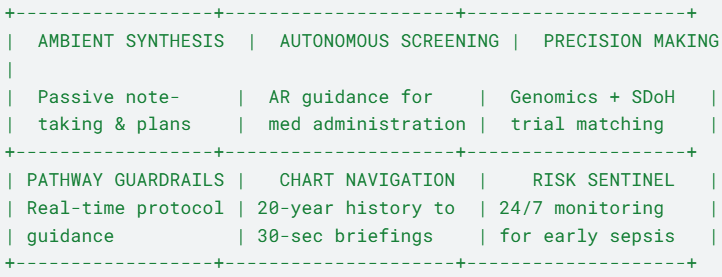
- Ambient Synthesis: Passively capturing the intent of each visit allows automatic generation of comprehensive care plans aligned with global guidelines through ambient synthesis.
- Autonomous Screening: Our autonomous screening system offers virtual/augmented reality guidance for auto-injector/infusion pump use and ensures accurate dosing rates (>95%), significantly reducing AE risk.
- Precision Making: By aligning patient’s genomics, social determinants of health (SDoH) and real time clinical trial data, we are able to optimize dosages and pro-actively prevent ADEs through precision making.
- Pathway Guardrails: Standardizes care delivery through real-time, gentle nudges for when clinicians’ orders veer off the established Gold Standards set by the enterprise.
- Chart Navigation: Concise summary of 20+ years of patient history fragmentation in 30 sec,ensuring all critical patient info is there.
- Risk Sentinel: Our AI works around-the-clock as a silent sentinel monitoring inpatient data-streams for signs of critical conditions such as sepsis and cardiac arrest giving health systems a 4-6 hour head start on these events.
The Enterprise Impact: Quantifiable Value Realization
The move to intelligent orchestration goes beyond the operations domain, providing tangible gains in both the bottom line and care quality along every link in the facility value chain.
| Metric Area | Impact & Realization | Operational Outcome |
| Efficiency | -3.5 hours/day | Cuts manual charting time, restoring eye-to-eye clinician-patient connection. |
| Safety | 22% reduction | Lowers diagnostic “miss” rates through agent-led pre-screening. |
| Compliance | 100% adherence | Ensures full compliance with MIPS/HEDIS quality measures via pathway guardrails. |
| Retention | 40% reduction | Decreases provider burnout scores tied directly to documentation effort. |
Diagnostic Precision: Minimizing False Negatives
With early detection being such a critical factor when it comes to detecting life threatening conditions, the ability to have this second pair of eyes that are on constantly and very specialized can help you detect what would take your diagnostic team several hours, in seconds. –Diagnostic Synthesis Agent
Key Outcomes:
- 95% faster turnaround time on radiology reports.
- 30% more cancers caught at early Stage I.
- 15–25% overall improvement in diagnostic sensitivity.
Agent Logic in Action: Two Blueprint Cases
To learn more about how high-velocity intelligence works to power your everyday operations, here’s an exploration of the fundamental reasoning behind these two key use cases.
Case 1: Diagnostic Synthesis
Goal: Correlate complex, multimodal data streams enabling instant anomaly detection and triage.
Data Ingestion: Ingest DICOM imaging, pathology slides, and lab results via standard HL7/FHIR protocols. Correlation: Cross analyze multimodal patterns over MRI/CT scans to detect systemic anomalies.
Anomaly Mapping: Highlights subtle lesions & red-flag findings that can escape detection during extended shift lengths.
Priority Triage: Instantly promotes critical/high risk cases (e.g., acute stroke) to the top of radiology worklists
Draft Reporting: Provides 95% complete preliminary report ready for clinical review & action
Case 2: Ambient Scribing
Goal: Restore the Human Connection By passively capturing & structuring clinical encounters
- Passive Listening: We listen in on your conversations with clinicians (no manual input or wake-words needed)
- Context Extraction: We leverage our domain-specific Clinical NLP to extract clinical intent, symptoms reported, proposed plans & more
- Synthesis: Cross reference the patient’s context with the most up-to-date evidence available on global Journals/ministry guidelines.
- EHR structure: Automatically map structured clinical narrative onto relevant fields of the EHR.
- Validation: Present this as a structured note to the clinicians, who can quickly validate and approve.
The Path Forward
It’s no secret that high-velocity healthcare intelligence has become an essential part of clinical decision-making. However, this kind of intelligence is designed to amplify clinicians’ skill sets while allowing them to focus on what really matters-their patients.
Deploying specialized AI agents to perform complex tasks such as data synthesis, chart navigation and documentation enables healthcare organizations to safeguard margins, empower their staffs and ultimately deliver faster, safer patient care.